
If quantum information were a letter, photons would be the ideal messengers.
How can we issue commands so that these messengers know precisely where to go (direction), in what form (polarization), and at what “volume” to speak (intensity)? Associate Professor Fei Ding’s team and collaborators have turned this vision into reality.

Recently, the team led by Associate Professor Fei Ding from the Division of Information Science and Technology, together with collaborators, has realized customized photon generation for the first time on a microchip merely 10 micrometers wide — a fraction of the diameter of a human hair. This photon source enables on-demand control over photon direction, polarization and intensity, opening up new avenues for future quantum communication, quantum computing and high-precision sensing.
This landmark result, titled On-Chip Emitter-Coupled Meta-Optics for Versatile Photon Sources, has been published in Physical Review Letters (PRL), a premier international physics journal. Owing to its significance, the work was selected as an Editors' Suggestion and featured on the journal’s website. Meanwhile, Physics, the authoritative journal of the American Physical Society (APS), highlighted this research in a feature story entitled “Microchip Provides Made-to-Order Photons”.
The Challenge: Tailoring Photons to Exact Specifications
Photons serve as ideal carriers of quantum information, capable of transmitting data at high speed while being robust against environmental disturbances.
To harness photons on a compact quantum chip, customized control is essential: researchers need to precisely manage where photons are emitted, their polarization state, and emission intensity.
Previous approaches either relied on bulky optical components or suffered from limited control degrees of freedom, making them incompatible with the miniaturization and high integration requirements of future quantum technologies.
The Breakthrough: An “Array of Nanoantennas” on the Chip
Ding’s team addressed this challenge by constructing an exquisite quantum emitter-metasurface coupling platform on the quantum chip.
The researchers employ nitrogen-vacancy (NV) centers in nanodiamonds as quantum emitters. Upon laser excitation, these emitters generate surface waves known as surface plasmons. As the waves propagate along the chip surface, they encounter an array of elaborately engineered “meta-atoms” — resembling a miniature grid of antennas. These structures re-radiate the surface waves and scatter them back into free-space photons.
By tuning the dimensions and layout of these antennas, the researchers skilfully combine resonant phase and geometric phase effects. Much like tuning a musical instrument, they achieve fine control over photon direction, polarization and intensity.
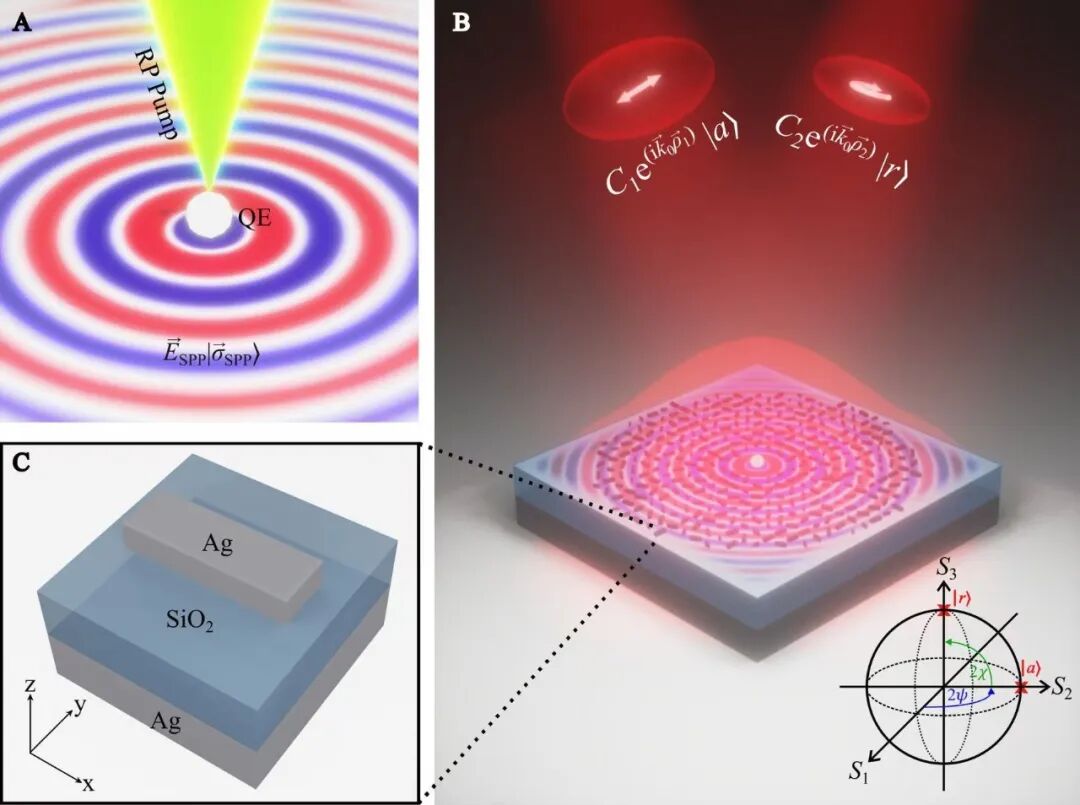
Figure 1. Realization of “customized photons” on a microchip. Laser pulses (Panel A) excite nitrogen‑vacancy centers in nanodiamonds to generate surface plasmons (marked by red and blue circles in Panels A and B). As these surface waves propagate outwards, they encounter an array of nano meta‑atoms and are rescattered into photons. By selecting the dimensions and arrangement of the antennas, photons with arbitrary emission directions or polarization states can be generated (linear and circular polarization are illustrated in Panel C).
Achievements: Sophisticated Control at the Micrometer Scale
The team achieved several critical breakthroughs in experiments: 01 Highly directional single-channel photon emission: Linearly or circularly polarized light can be emitted at designated angles, with a polarization purity close to 99%. 02 Multi-channel photon source: Photons with multiple emission directions and distinct polarization states can be output simultaneously, enabling quantum parallel processing. 03 Tunable intensity: Energy can be flexibly allocated among different photon channels to realize a true on-demand light source. 04 Complex emission patterns: More intricate phase profiles can be introduced to generate structured beams such as vector beams and vortex beams.
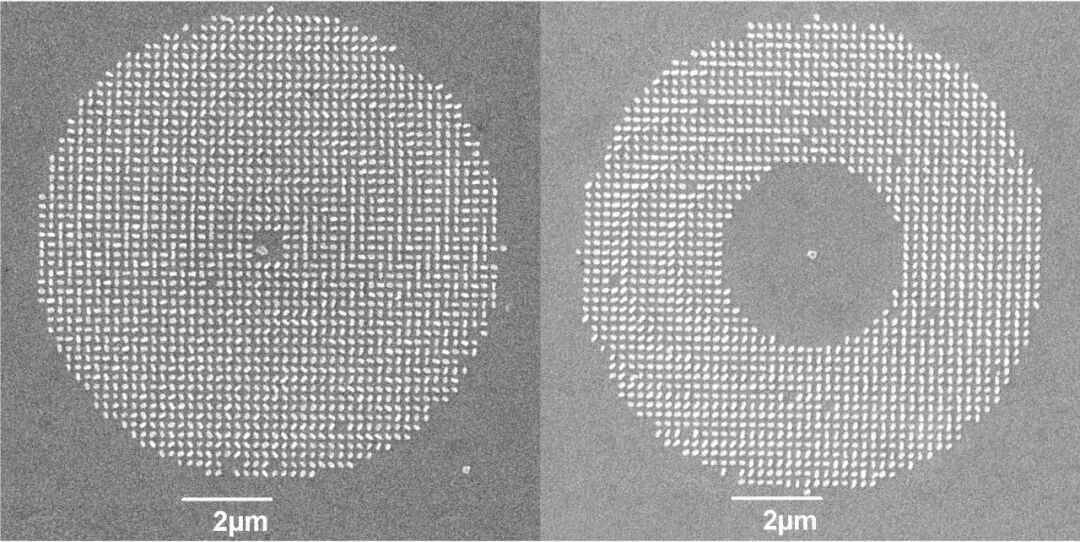
Figure 2. Scanning electron microscopy (SEM) images of the sample. The two antenna arrays in the left and right panels generate linearly polarized photons (left) and circularly polarized photons (right), respectively, which are emitted along designated directions. The polarization state of photons is not determined by the overall shape of the array (e.g., disk or ring), but by the precise arrangement of the antennas. Each array has a diameter of approximately 10 micrometers.
These results demonstrate that sophisticated manipulation previously achievable only with macroscopic optical systems can now be implemented on a chip at the 10‑micrometer scale, laying a foundation for the development of miniaturized quantum optical devices.
Links to the paper and related coverage:
https://journals.aps.org/prl/abstract/10.1103/klq1-wjjg
https://physics.aps.org/articles/v18/151