

The era of sixth‑generation (6G) mobile communications is drawing near. Researchers are envisioning an innovative communications paradigm: instead of individual satellites operating in isolation, multiple satellites will join forces in space to deliver faster, more reliable and smarter network services.
Recently, the team led by Assistant Professor Bodong Shang at Eastern Institute of Technology (EIT), Ningbo, published a survey paper titled Multi‑Satellite Cooperative Communications for 6G: Fundamentals, System Design, and Applications in IEEE Communications Surveys & Tutorials, a top‑tier international journal in communications with an impact factor of 46.7.
The research team identifies six cutting‑edge research directions. Among them, multi‑satellite cooperative computing and integrated sensing and communication stand out. In the future, satellites will not merely transmit data; they will process information like “space‑borne computers” and even gain sensing capabilities, enabling the convergence of communication, sensing, computing and intelligence.
Why should satellites “team up”?
Rising demands for higher network speed, lower latency and broader coverage have rendered single‑satellite solutions insufficient. This limitation becomes especially prominent in remote regions, maritime zones and airspace where terrestrial networks cannot reach. As satellite‑based services keep expanding, one satellite alone can hardly handle all workloads. Multi‑satellite cooperation functions as a well‑coordinated team: some satellites handle user access, some serve as relay nodes, and others manage resource scheduling. Working in synergy, they enable high‑quality network access for users anywhere on Earth.
How do satellites cooperate with one another?
The team summarizes three major cooperative architectures (illustrations courtesy of the research group):
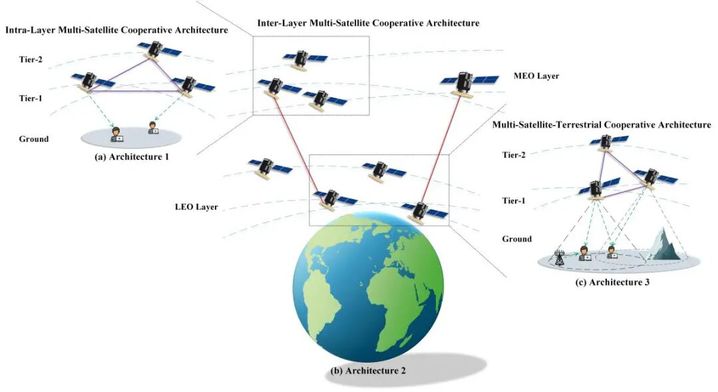
Intra‑layer cooperation: Satellites sharing the same orbital height are interconnected via inter‑satellite links to form satellite clusters, providing low‑latency services for end‑users.
Inter‑layer cooperation: Satellites in different orbits (e.g., LEO and MEO satellites) perform divided tasks. LEO satellites manage user access, while MEO satellites undertake data relaying.
Satellite‑terrestrial cooperation: Satellites work in tandem with ground base stations. Users can connect to both satellite and terrestrial networks simultaneously to boost connection reliability.
Five operating modes empower intelligent satellite cooperation
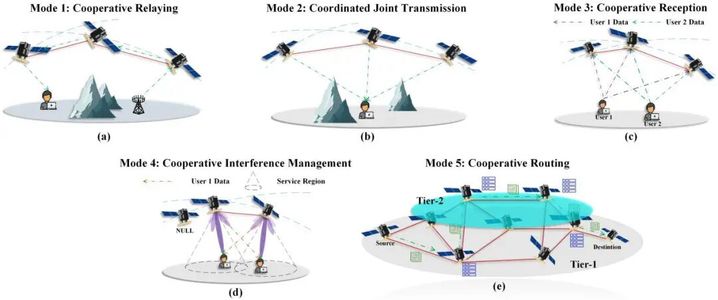
Five operating modes empower intelligent satellite cooperation
The study further categorizes five operating modes for multi‑satellite cooperative networks, which serve as distinct “tactics” for the satellite constellation (illustrations courtesy of the research group):
Cooperative relaying: Satellites forward signals for one another to extend service coverage.
Joint transmission: Multiple satellites send data to end‑users concurrently for improved transmission efficiency.
Cooperative beamforming: Signal superposition across satellites enhances signal reception quality.
Interference management: Intelligent scheduling mitigates mutual signal interference among satellites.
Cooperative routing: Optimizes data transmission paths within satellite networks to cut down latency.
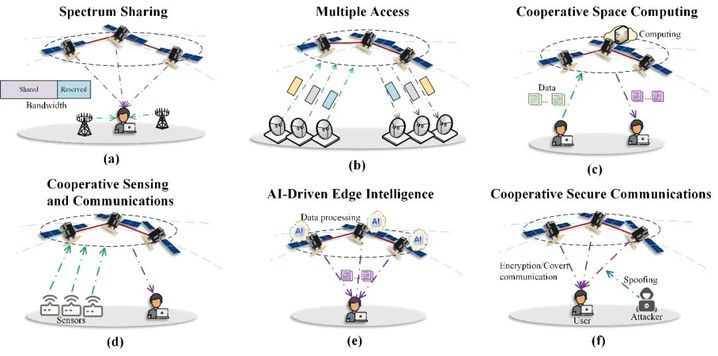
Future satellites: More than signal transmitters, but also data processors
Multi‑satellite cooperative communications is recognized as a core enabling technology for ubiquitous 6G coverage. It delivers an efficient, feasible technical framework for next‑generation space‑air‑ground‑sea integrated communications.
The technical system and theoretical framework proposed in this paper are also applicable to satellite internet, communication‑computing convergence and many other scenarios, demonstrating broad cross‑scenario applicability. This work marks a key advance in 6G satellite communications and cooperative networking. It delivers solutions for building a unified knowledge system, clarifying technical taxonomies and developing implementable optimization strategies.
Guided by the technical framework and research roadmap laid out in this survey, we are on track toward more efficient, robust and fully‑covered 6G communication networks. Future satellites will not only relay data but also execute computing tasks as space‑borne computers with sensing functions, realizing the integration of communication and sensing.
(Schematic diagrams for the six prospective research directions of multi‑satellite cooperative networks are provided by the research group.)
Eastern Institute of Technology serves as the primary affiliation for this paper. Bodong Shang is the first author. Co‑authors include Xinyi Huang (joint‑Ph.D. student of EIT and University of Science and Technology of China), Huayuan Wang (joint‑Ph.D. student of EIT and The Hong Kong Polytechnic University), and Xiangyu Li (joint‑Ph.D. student of EIT and Shanghai Jiao Tong University). Professor Meixia Tao from Shanghai Jiao Tong University acts as the corresponding author. Additional collaborators are Professor Haijun Zhang from University of Science and Technology Beijing and Professor Pingzhi Fan from Southwest Jiaotong University.
Paper link: https://ieeexplore.ieee.org/document/11370831
About the Research Group

Bodong Shang, Assistant Professor The group conducts frontier research covering 6G communications, space‑air‑ground‑sea integrated networks, and communication‑computing convergence. Postdoctoral researchers, Ph.D. candidates and research intern openings are available. Talented young professionals passionate about future communications technologies are welcome to apply.
Contact: bdshang@eitech.edu.cn
Group homepage:https://shangbodong.github.io/